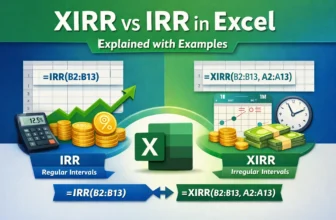
IRR and XIRR are both financial metrics that people use to decide the best project for them to invest in. IRR is a tedious calculation, and XIRR is even more so. Fortunately, Microsoft Excel provides ...
Businesses often use Excel files for various tasks. Important Excel files are often shared with the associates of the business. However, if an employee edits the master file by mistake, other ...
In Excel, pivot tables can be used to accomplish a lot of things. As pivot tables do their own calculations automatically, if we want to make a change and add more formulas, we have to do it using ...
Calculated fields are often used in Excel to calculate new values from the existing fields. However, calculated fields are usually done for rows in a pivot table. Although it’s rare, sometimes you ...
The values of a pivot table can do different types of calculations, but if you need the number of distinct counts, that option is not usually visible. Imagine you have students from different ...
A pivot table is an excellent tool to show data with regular and numerical values. It automatically counts the subtotals and grand totals of the fields and shows them in the table without manual ...
If you have multiple pivot tables in the same worksheet, you might be familiar with the error that says “A pivot table report cannot overlap another pivot table report”. Microsoft Excel does not ...
Pivot tables are one of the oldest yet useful data analysis tools in Excel. The columns, rows, and values of a pivot table can be easily manipulated, which makes it a popular choice for data ...
A pivot table is a widely used tool in Microsoft Excel. In order to do data analysis, pivot tables help in many ways. A way to make pivot tables more useful is to add the pivot table data to the data ...